

Can You Have a Shinto Wedding with Just the Two of You? A Guide to Eloping in Japan
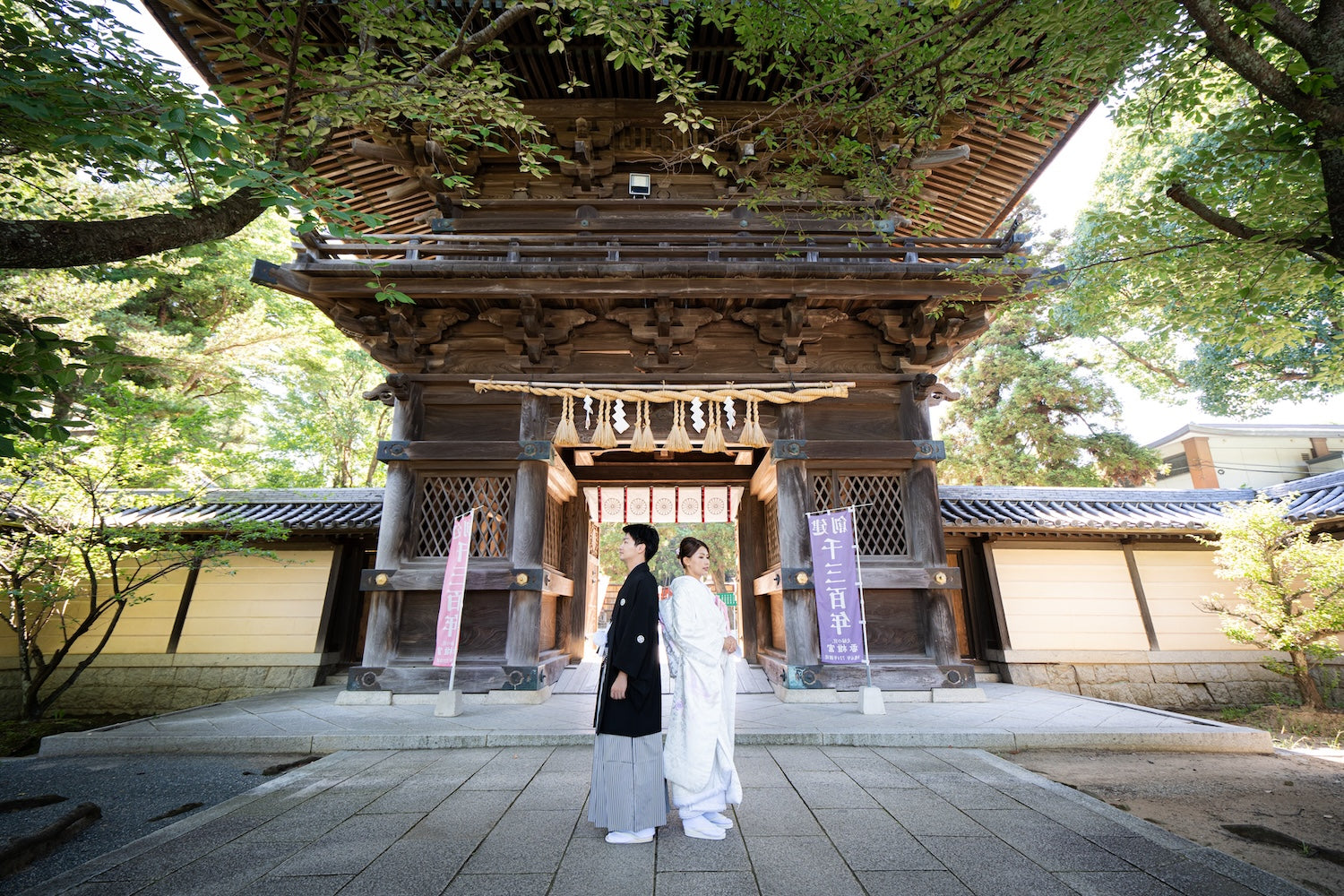
In short: WAKON STYLE publishes no minimum guest count, but whether a shrine accepts a ceremony for only two people must be confirmed for that shrine. The current brochure's Type 2 plan is a ceremony-and-photo plan priced at 275,000 yen including tax and interpretation. The ceremony fee, approximately 100,000 yen, is separate. Photography covers about 150 images around the shrine or temple precincts or during the ceremony, with selected data delivered in about 30 days. This is not a photo-only package.
Most of what comes up when you search for eloping in Japan is written by photographers, and it shows. The pages are full of scenic backdrops, golden-hour light, and couples in rented kimono standing in front of a shrine gate. What is much harder to find is an answer to the question a couple actually planning a Shinto wedding has: is a real ceremony, exchanging vows before the gods, something you can do with just the two of you, and what exactly does that involve.
This guide stays on that side of the question. It sets out what a two-person Shinto wedding actually includes, how it differs from a kimono photo session with no ceremony attached, what shrines expect when there is no guest list, and how quickly the whole thing can come together if your trip to Japan is already booked.
Table of Contents
- Can you have a Shinto wedding with just the two of you?
- What's included if you elope in Japan?
- Is the 275,000-yen plan photo-only?
- Do shrines allow ceremonies without guests?
- How quickly can you arrange it?
- What does the day look like for two people?
- FAQ: eloping in Japan for a Shinto wedding
- Who supervised this guide?
Can you have a Shinto wedding with just the two of you?
There is no published minimum guest count for a Shinto ceremony. That does not amount to a guarantee that every shrine accepts a ceremony for two, so confirm the guest-count rule for your chosen shrine when you enquire.
What it does not do is state that you cannot bring anyone. The package page simply does not mention a guest count in either direction. Whether shrines will accommodate additional people alongside the two of you is a separate question, covered later in this guide, and it is one you should confirm rather than assume.
What's included if you elope in Japan?
The current brochure lists Type 2, “Wakon ceremony + Photo-shooting plan,” at 275,000 yen including tax and interpretation. It combines the ceremony arrangements, attire, styling and photography, but the ceremony fee is separate.

| Item | What it covers |
|---|---|
| Photography | Around the shrine or temple precincts or during the ceremony; approximately 150 images, with selected data delivered within about 30 days |
| Bride's attire | Shiromuku or Iro-uchikake, Standard Grade, 1 outfit |
| Groom's attire | Montsuki and Hakama, Standard Grade, 1 set |
| Kimono accessories | Full set for both of you, coordinated with the attire |
| Bridal styling | 1 person, Japanese-speaking staff, dressing, hair, and makeup |
| Dedicated bridal assistant | 1 person, Japanese-speaking only |
| English-Japanese interpreter | 1 person, bilingual, present throughout |
| Shrine or temple selection and booking | Full support from choosing a venue to confirming the reservation |
| Kimono photo support | Guidance on scheduling and the photography process |
| Ceremony fee | Separate; approximately 100,000 yen |
| Possible additional cost | Dressing room, 22,000 yen if required; transport such as taxis when necessary |
The attire is listed as Standard Grade, one outfit for the bride and one set for the groom, so this is not the plan to reach for if you have a specific premium fabric or a second outfit change in mind. And the team that dresses you, styles you, and photographs you communicates in Japanese as a matter of course, with an English-Japanese interpreter built into the package to bridge that gap throughout the day, not left to chance or a translation app.
The brochure does not establish that every shrine accepts a two-person ceremony. If a particular shrine or region matters to you, confirm both availability and guest-count conditions directly.
Is the 275,000-yen plan photo-only?
No. Type 2 is explicitly a ceremony-and-photo plan. The ceremony fee is paid separately, but the ceremony itself is part of the plan's scope. The current brochure does not publish a separate photo-only plan or price, so couples who want photography without a ceremony should ask WAKON STYLE what is currently available.
Do shrines allow ceremonies without guests?
There is no published cap that requires a minimum, but there is no blanket guarantee either, and the honest answer is that it depends on the shrine. WAKON STYLE's FAQ states that any limit on guest numbers "varies depending on the shrine," which cuts both ways: some shrines that welcome a party of twenty may set different expectations for a party of two, and the only way to know is to ask about your specific venue.

The booking process itself is written in a way that leaves room for a couple alone. When WAKON STYLE asks for guest numbers ahead of a ceremony, the request is phrased as "if inviting guests besides the couple, we need accurate numbers for venue preparation," which reads as a conditional rather than an assumption that guests will be present. It is not the same as an explicit statement that ceremonies for two are always accepted, but it does not treat a guest list as mandatory either.
One more constraint shapes which shrines are realistically available to you. The WAKON STYLE FAQ is clear that only a limited selection can be booked through the service. This is separate from guest-count rules, and both points should be confirmed when you contact WAKON STYLE.
How quickly can you arrange it?
In some cases, arrangements can be made on a short timeline, but availability varies by shrine and date.
Visiting Japan in advance is not normally required because planning can proceed by email. If a venue, beauty services and a photographer can all be secured, preparation may be possible in as little as two weeks. Treat that as an exception, not a guarantee.
Two weeks is the floor, not a promise for every date or every shrine, since availability depends on what is open when you ask. If you want the fuller picture of how far in advance different pieces of a Shinto wedding typically need to be locked in, our guide to how far in advance to book a Shinto wedding lays that timeline out, and whether you need to visit Japan before your wedding covers what can and cannot be settled remotely before you arrive.
What does the day look like for two people?
Essentially the same shape as any Shinto wedding, because the ceremony itself does not change based on guest count. WAKON STYLE's sample schedule runs from 8:45 in the morning to a 13:10 conclusion, with times varying based on the shrine and booking status. That is roughly four and a half hours for a ceremony that lasts about thirty minutes, and the reason is preparation and photography rather than anything to do with how many people are watching. The hour-by-hour breakdown, and what it means for how many days to set aside, is laid out in our guide to how many days you need in Japan for a Shinto wedding.

Without a guest list to coordinate, the morning is simpler to plan around even though its shape stays the same: no one else's flight, hotel, or attire needs to line up with yours. What happens inside the ceremony itself, from the procession to the exchange of sake cups, is covered separately in our guide to what actually happens at a Shinto wedding. For the ceremony itself and everything WAKON STYLE's support covers beyond a booking for two, the Shinto wedding overview is the main reference.
What comes after the ceremony is also open to you either way. A photo session at a traditional landscape or tourist spot is possible with WAKON STYLE's own photographers, and a meal or celebration afterward is entirely optional when there is no guest list to host. Our guide to what happens after a Shinto wedding covers both.
FAQ: eloping in Japan for a Shinto wedding
One question is not covered above: whether family or guests can be added after you have settled on a ceremony for two.
Can we invite family later, or add guests on the day? Possibly, but it depends on the shrine, and guest numbers need to be declared in advance for venue preparation if you do invite anyone. If bringing family is a real possibility, our guide to bringing family and guests to a Shinto wedding covers what changes once other people are involved.

Who supervised this guide?
Supervised by Etsuko Inoue, WAKON Wedding Producer
View Etsuko Inoue's full profileEtsuko Inoue has produced international Shinto weddings since 2017. Her profile shares more about her background and how she works with couples planning a wedding in Japan.
If a ceremony for just the two of you is what you are picturing, contact WAKON STYLE with your travel dates and preferred area to confirm shrine availability, guest-count conditions and the current plan details.
Contact Us

