Real Wedding Story
01


In short: A typical Shinto wedding takes about 30 minutes and follows eight main steps: Sanshin, Shubatsu, Norito-sojo, San-san-kudo, Seishi-sodomoku, Ring Exchange, Tamagushi-hoten, and Shinzoku-hai. The exact order and ritual details can vary by shrine, and international couples should expect to read a short wedding vow in Japanese, with advance preparation and support.
Knowing the name of a ceremony is not the same as knowing what you will actually do during it. Many international couples arrive at their Shinto wedding having read a short overview of the ritual's history, but with no real sense of what happens moment to moment, or what is expected of them personally. This guide walks through the ceremony as a sequence of things you will experience and participate in, so that the day feels familiar rather than unpredictable, even if you have never attended a Shinto wedding before.
That distinction, between reading about a ritual and knowing what your own part in it will be, is the gap this guide is written to close. Rather than repeating a general encyclopedia-style account of Shinto wedding history, it focuses on the couple's actual experience: where you will walk, what you will be asked to do, and which moment is genuinely yours to prepare for in advance.
The ceremony usually moves from procession and purification to prayers, sake sharing, vows, a ring exchange, a sacred branch offering, and a family cup ritual. WAKON STYLE presents the standard sequence as the following eight steps, although individual shrines may adjust the order.

| # | Official name | Plain-English role |
|---|---|---|
| 1 | Sanshin | Couple's Procession to the Altar |
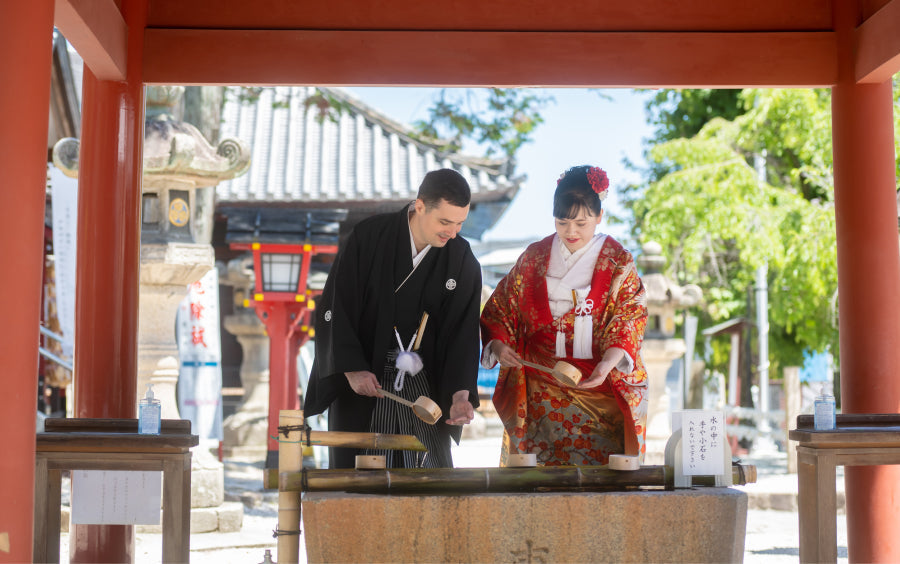
| 2 | Shubatsu | Symbolic Purification |
| 3 | Norito-sojo | Priest Reports Marriage to the Gods |
| 4 | San-san-kudo | Ceremony of Three Cups |
| 5 | Seishi-sodomoku | Reading of Vows |
| 6 | Ring Exchange | Popular Modern Element |
| 7 | Tamagushi-hoten | Offering Sacred Branches |
| 8 | Shinzoku-hai | Family Cup Exchange |
The ceremony opens with Sanshin, a quiet procession in which the couple walks toward the altar, a moment intended to mark respect for the marriage and for the gods before the ritual itself begins. This is followed by Shubatsu, a symbolic purification performed by the priest using a sacred branch, to clear away the ordinary concerns of daily life before the sacred part of the ceremony continues. In Norito-sojo, the priest formally reports the marriage to the gods, asking for their acknowledgment and blessing. For a couple standing through this part of the ceremony, the practical experience is mostly one of walking, standing, and receiving these opening rites, rather than actively performing them.
San-san-kudo is the well-known ceremony of three cups: the couple shares sake from three cups, taking three sips from each, nine sips in total. The structure carries symbolic meaning tied to the site's own description of the ritual, representing past, present, and future through the cups, and respect for the gods, family, and guests through the number of sips. This is followed by Seishi-sodomoku, the reading of the vows, which is the part of the ceremony where the couple speaks directly, in their own voice, in front of the priest and their guests. Because of what this step actually involves for international couples, it is addressed in more detail in the next section of this guide.

The ring exchange is a comparatively recent addition, influenced by Western wedding customs, and it is now offered by request at many Shinto ceremonies as a symbol of enduring commitment. In Tamagushi-hoten, the couple offers a sacred sakaki branch to the altar, a gesture of gratitude and prayer toward the gods. The ceremony closes with Shinzoku-hai, in which both families share cups together, marking the joining of the two families rather than only the couple. Because shrines differ in layout and custom, the exact choreography of these final steps, such as who moves first or how the cups are passed, is typically explained on the day by the priest or the accompanying staff.
In a WAKON STYLE Shinto wedding, the couple reads a short vow aloud in Japanese, usually taking about 90 seconds. The shrine provides a sample in advance, romanized readings are added, and the couple practises on their own with this support until they can read it through before the ceremony.
This is often the moment couples feel most nervous about in advance, and also the one they remember most clearly afterward. The words spoken aloud are treated as the heart of the ceremony: without them, the ritual is considered incomplete. In practice, the shrine sends a sample text ahead of the day, WAKON STYLE adds romanized readings alongside the Japanese characters, and the couple practises on their own until they can read the vow through in their own voice. This is not a matter of achieving fluent Japanese pronunciation. It is closer to learning to read a short passage phonetically, with support, so that the moment belongs to the couple rather than feeling like a performance of someone else's words. Because shrines vary in exactly how vows are handled, it remains worth confirming the specifics for your chosen shrine rather than assuming every location follows an identical process.
Yes. A Shinto wedding at a shrine is a formal religious rite conducted by a Shinto priest, who performs the purification and reports the marriage to the gods. It should not be presented as a staged cultural performance, even though international couples can receive practical language and preparation support.
This distinction matters because some travelers have encountered, or heard about, commercialized wedding-style ceremonies elsewhere that borrow religious imagery without an actual religious officiant or rite behind them. A Shinto wedding at a shrine is a different thing entirely: the purification, the formal report of the marriage to the gods, and the offerings described above are performed by a Shinto priest as genuine religious acts, not as a scripted show for visitors. The language support, romanized vow readings, and interpretation that WAKON STYLE provides exist to help international couples participate fully and understand what is happening, not to convert the ceremony into a performance for an audience. If you or your family have questions about how this religious character sits alongside your own beliefs, a companion guide on whether you have to be religious for a Shinto wedding addresses that directly.
A Shinto wedding ceremony usually takes about 30 minutes, although timing varies by shrine and ceremony format. Couples should also allow separate time for dressing, preparation, movement through the shrine grounds, and any photography they have booked.
It is worth keeping this distinction in mind when you plan your day: the ceremony itself, from procession to the final family cup exchange, is a relatively short and focused ritual. The time you spend at the shrine overall will typically be longer once you add dressing, hair and makeup, walking between different areas of the grounds, and any photography or video you have arranged. If you are coordinating a schedule with guests traveling from abroad, planning around the roughly 30-minute ceremony window, plus additional time either side for these other elements, will give you a more realistic sense of the full day.
Review the ceremony order, practise the Japanese vow with its romanized reading, and confirm shrine-specific rules before the wedding day. WAKON STYLE's Shinto Wedding Package includes bilingual interpretation, a dedicated assistant, shrine selection and booking, and preparation support.
Familiarizing yourself with the eight steps above is less about memorizing exact wording and more about knowing roughly what comes next at each point in the ceremony. On the day itself, the priest and accompanying staff guide each stage, so the goal of preparation is confidence rather than performing every detail perfectly from memory.
Because the vow is read aloud personally, the preparation WAKON STYLE provides, a sample text, romanized readings, and rehearsal time, is designed to remove uncertainty about pronunciation rather than to test your language ability.
Details such as whether a rehearsal is available, how photography is handled during the ceremony, and how many guests can attend all vary by shrine. If you have not yet finalized which shrine to hold your ceremony at, a companion guide on how to choose a shrine for your Shinto wedding walks through how to weigh these factors before booking.
The exact order and ritual details can vary by shrine, but couples can prepare by learning the standard sequence and practising the Japanese vow. These short answers clarify the most common questions about participation and timing.
Does every shrine follow exactly the same order? No. The eight-step sequence is a useful standard guide, but the exact order and included elements can vary by shrine.
Are the wedding vows read in English or Japanese? Japanese is the standard language for the vow, with advance preparation and romanized reading support available through WAKON STYLE.
Do we have to memorize the ceremony? No. Couples should understand the sequence and practise the vow, then follow the guidance provided by the priest and support team on the day.
Is the ring exchange a traditional Shinto ritual? It is a newer element influenced by Western weddings, and it is now offered by request at many Shinto ceremonies.
How long does the ceremony last? It usually lasts about 30 minutes, although the timing varies by shrine.

Supervised by Etsuko Inoue, WAKON Wedding Producer
View Etsuko Inoue's full profileEtsuko Inoue has helped international couples prepare for the Japanese vow since 2017, coaching each couple until it feels like their own words. Her profile shares more about her background.
If you want to understand the ceremony at your preferred shrine or ask how the Japanese vow is prepared and rehearsed, contact WAKON STYLE for guidance.
Contact UsReal Couples, Real Experiences
Explore more real Shinto and Buddhist wedding experiences in Japan.