

Bringing Family and Guests to Your Shinto Wedding in Japan: What to Arrange in Advance
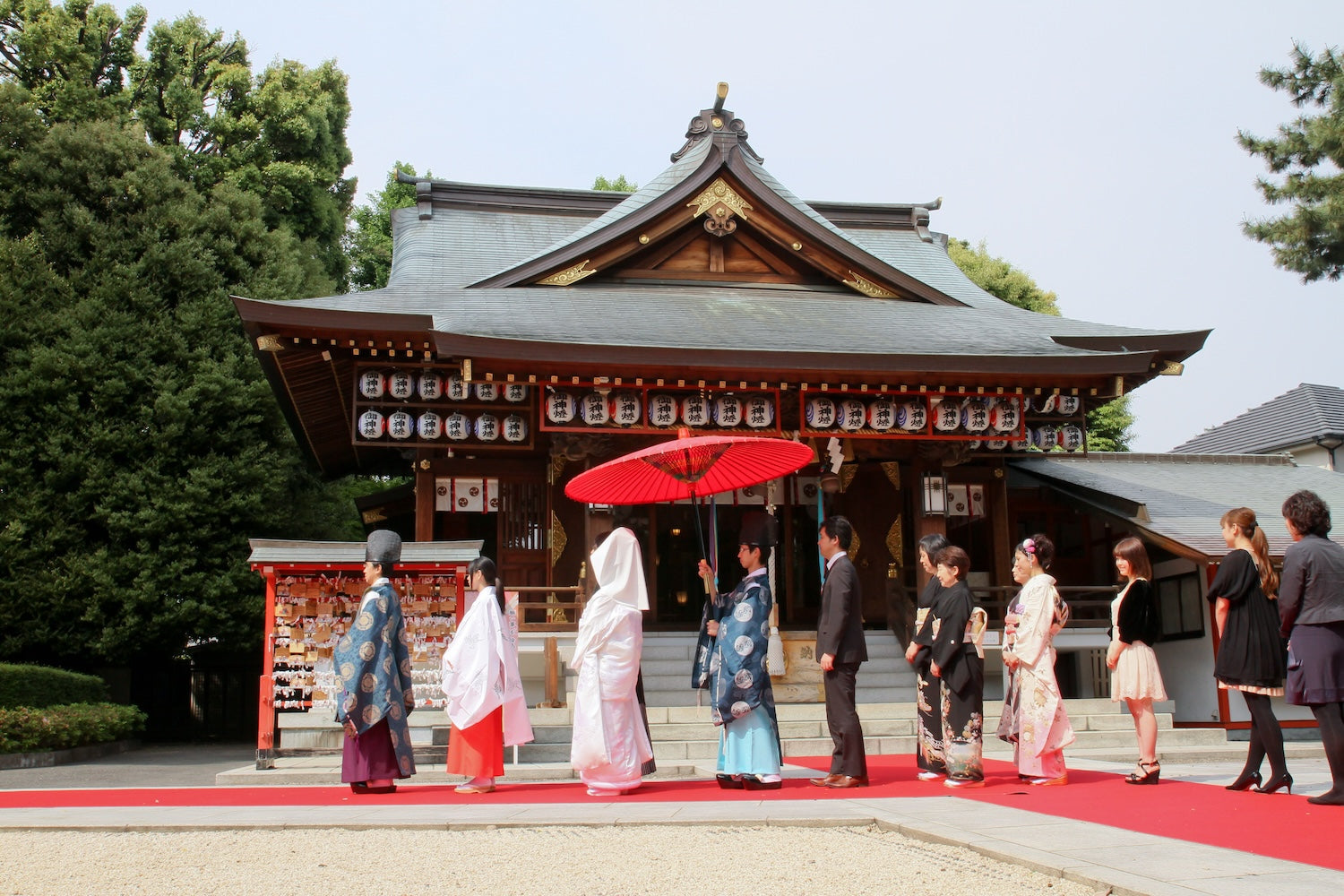
In short: Yes, you can bring parents, family, and friends to a Shinto wedding in Japan. How many depends on the shrine, and WAKON STYLE asks for your groom's-side, bride's-side, and total guest numbers when you book, since venue preparation depends on it. An English interpreter is included in the basic package; for other languages, WAKON STYLE uses an AI translation device (Pocketalk) rather than a live interpreter. A few practical details, from changing rooms to photography rules, vary by shrine and need to be confirmed for the specific venue you choose.
Couples planning a Shinto wedding from abroad tend to ask two questions in this order. First: can we actually bring people, or is this a two-person ceremony by nature? Second, once the answer is yes: what do we now need to organise that we would not have had to think about for just the two of us? The WAKON STYLE FAQ answers pieces of this across more than half a dozen separate entries, covering guest numbers, language, attire, facilities, and what happens afterwards, but nowhere as a single walkthrough.
This guide puts those pieces together in the order you would actually need them: whether guests can attend, how many, what they need to be told, what changes for older guests or children, and where everyone stays. It does not tell you the maximum headcount, because that is set by the shrine, not by WAKON STYLE, and it does not pretend to answer questions WAKON STYLE itself leaves open, such as step-free access. Where something depends on the venue, that is stated plainly rather than smoothed over.
Table of Contents
- Can you bring family and guests to a Shinto wedding?
- How many guests can attend, and what needs to be arranged in advance?
- Will your guests understand the ceremony?
- What do guests need to know before the day?
- What about older guests or children?
- Where do guests stay?
- What happens after the ceremony with guests?
- FAQ: bringing family and guests to a Shinto wedding
- Who supervised this guide?
Can you bring family and guests to a Shinto wedding?
Yes. A Shinto wedding is not limited to the couple, and WAKON STYLE's booking process is built to account for guests: it asks for the number attending on each side and in total. What is not fixed is how many: the capacity varies from shrine to shrine, and WAKON STYLE asks couples to confirm and report their guest count in advance so that the venue can prepare properly.
This is information the shrine and the team need ahead of time, in the same way a restaurant needs a party size before it seats you. If you already know roughly how many people are coming, sharing that early makes the rest of the planning easier for everyone. And if the honest answer is that nobody is coming, that is its own valid plan.
How many guests can attend, and what needs to be arranged in advance?
There is no single number, because capacity depends on the shrine you choose. The WAKON STYLE FAQ is direct about this: the limit varies by venue, and couples are asked to consult individually so the team can confirm accurate numbers for the specific shrine under consideration. If a guest list of a particular size matters to you, raise it early in the shrine selection conversation rather than after a booking is close to final.

What is consistent, regardless of shrine, is the information WAKON STYLE asks for at booking. The Important Information Before Booking page sets out a specific request under Guest Count Information: the number of groom's guests, the number of bride's guests, and the total. This information is crucial for booking, and couples are asked to confirm and report the guest count in advance so preparations go smoothly. In practical terms, this means you should have at least a working estimate of these three numbers before you get deep into the booking process, even if the final list is not locked down yet.
Worth noting is what those three fields actually are: the booking form asks for the number of groom's guests, the number of bride's guests, and a total. WAKON STYLE's site does not spell out how the form should be filled in for every kind of couple, and where that raises questions specific to same-sex couples and their families, our guide to Shinto weddings for same-sex couples in Japan covers that ground in more detail; this guide focuses on the logistics that apply to any guest list.
Will your guests understand the ceremony?
Mostly, yes, but the way language is handled is worth understanding precisely, because it is easy to describe incorrectly. WAKON STYLE's basic wedding package includes an English interpreter. For any other language, the team does not provide a live interpreter on site; instead, they use an AI translation device, currently Pocketalk, to support communication. If your guests speak a language other than English or Japanese, plan around a translation device rather than assuming a human interpreter will be present for them.

This distinction matters in practice. An English-speaking parent or friend can expect a person interpreting for them throughout the day. A guest who speaks, say, Portuguese, Mandarin, or Hebrew should expect device-based translation support rather than a dedicated interpreter.
Beyond the ceremony itself, WAKON STYLE has prepared videos explaining Shinto wedding etiquette and procedures, and these can help guests who want to understand what they are watching before they arrive. The team also provides detailed guidance on shrine manners directly, which is worth requesting for your guests as well as for yourselves. The ceremony's own content, including the vows read aloud and the exchange of sake cups, is conducted in Japanese as standard practice; what that involves step by step is covered in our guide to what actually happens at a Shinto wedding, which your guests may find useful reading before the day.
What do guests need to know before the day?
One requirement applies to everyone attending, not just the couple: wearing socks or stockings is mandatory, and WAKON STYLE specifically asks couples to inform all their guests of this before the day. It is a small detail, easy to forget when a guest is choosing shoes for a formal event, so it is worth passing on explicitly rather than assuming it is obvious.
This guide does not go through what guests should actually wear, since dress expectations for a Shinto wedding are covered in full in our guide to what to wear to a Shinto wedding in Japan. What belongs here is the arrangement point: make sure the sock or stocking rule reaches everyone on your guest list, ideally well before they pack.
Photography is the other detail that catches guests out. Rules on where and when guests can take photos or videos during the ceremony vary by shrine, and WAKON STYLE provides the specific restrictions for whichever venue you choose once it is confirmed. Rather than assuming your guests can film freely, it is worth passing on the shrine-specific rules to them in advance, particularly if a guest is hoping to capture a specific moment.
What about older guests or children?
Two practical factors shape this more than anything else: many shrines do not have changing rooms, and the day runs longer than the ceremony itself suggests. Neither is a reason to leave older relatives or young children at home, but both are worth planning around rather than discovering on the day.
On changing rooms: facilities vary by shrine, and while most have restrooms and powder rooms, many shrines do not have a changing room, so the couple is generally asked to arrive already dressed for the ceremony. In practice this means preparation may happen at a separate location before travelling to the shrine, and that journey is not left to chance: taxi services can be arranged according to your needs, moving people from where they are staying to the ceremony itself. For a guest who cannot walk long distances easily, confirming this transport in advance is worth doing directly with your planner rather than assuming it.
On length: the ceremony itself takes about thirty minutes, but the wedding day as a whole is longer, and our guide on how many days you need in Japan for a Shinto wedding sets out a published sample schedule running roughly four and a half hours from arrival to conclusion. For an older guest, or anyone with limited stamina, that is worth knowing ahead of time so they can plan rest, seating, or a shorter attendance window in conversation with the couple and the venue.
On accessibility specifically, there is no published information from WAKON STYLE about step-free access or wheelchair accommodation at its partner shrines, and it would be misleading to guess. If accessibility is a real concern for someone in your party, raise it directly with your planner for the specific shrine you are considering, since shrine grounds, some centuries old, vary enormously in terrain, steps, and gravel paths.
On children: this is a question to raise directly rather than settle from a website. WAKON STYLE does not publish guidance on a minimum age, on whether children count toward a shrine's guest limit, or on what is available for them during the ceremony, so those points belong in the guest numbers you confirm at booking and in the conversation about your specific shrine. The practical factors above apply to them as much as to older relatives: a long morning, a journey to the shrine in formal dress, and the sock or stocking requirement that applies to everyone attending.
Where do guests stay?
WAKON STYLE can introduce hotels and recommended accommodation near the shrine, and for some of these hotels, the team can handle the entire process from reservation through to payment on your behalf. Staying close to the ceremony venue is worth prioritising for exactly the reasons above: an early start, a long day, and guests who may prefer not to travel far first thing in the morning.
Shrines themselves typically do not have accommodation facilities. The one notable exception is at some temples, where a "shukubo" experience, an overnight stay within the temple grounds, is available. If that kind of stay appeals to your group, it is worth asking about directly, since it is not offered everywhere and depends on the specific venue. It is also one of the practical differences between the two kinds of venue, which our guide on choosing between a shrine and a temple sets out alongside the rest of the comparison.
What happens after the ceremony with guests?
Depending on where your ceremony takes place, WAKON STYLE can introduce Japanese and Western-style restaurants and banquet halls near the shrine. What WAKON STYLE commits to is the introduction itself; how far the arrangements go from there is worth confirming directly rather than assuming a full reception is organised for you. Having your guest count settled makes that conversation easier, since it shapes what kind of venue is worth looking at.

What that meal looks like, how it differs from a Western-style reception, and what else typically follows the ceremony is covered in full in our guide to what happens after a Shinto wedding. If you are trying to picture the whole day for your guests, including the part after the ceremony ends, that guide is the next one to read.
For the ceremony itself and what WAKON STYLE's support covers more broadly, the Shinto wedding overview is the main reference, and the FAQ answers a number of smaller practical questions about guests, facilities, and logistics that are not covered here in full.
FAQ: bringing family and guests to a Shinto wedding
This covers one point not addressed above: what children should wear for the ceremony.
Can children take part in the ceremony dressed in kimono? This is not something WAKON STYLE publishes guidance on, so it needs to be raised directly rather than assumed. Include children in the guest count you report at booking and ask about attire for them at the same time.

Who supervised this guide?
Supervised by Etsuko Inoue, WAKON Wedding Producer
View Etsuko Inoue's full profileEtsuko Inoue has produced international Shinto weddings since 2017. Her profile shares more about her background and how she works with couples planning a wedding in Japan.
If you are planning to bring family or guests, contact WAKON STYLE with an idea of your numbers and the shrine you are considering, and the team can confirm what is possible for that specific venue.
Contact Us

