

Will a Japanese Wedding Kimono Fit Me? Sizes, Fittings, and What's Included
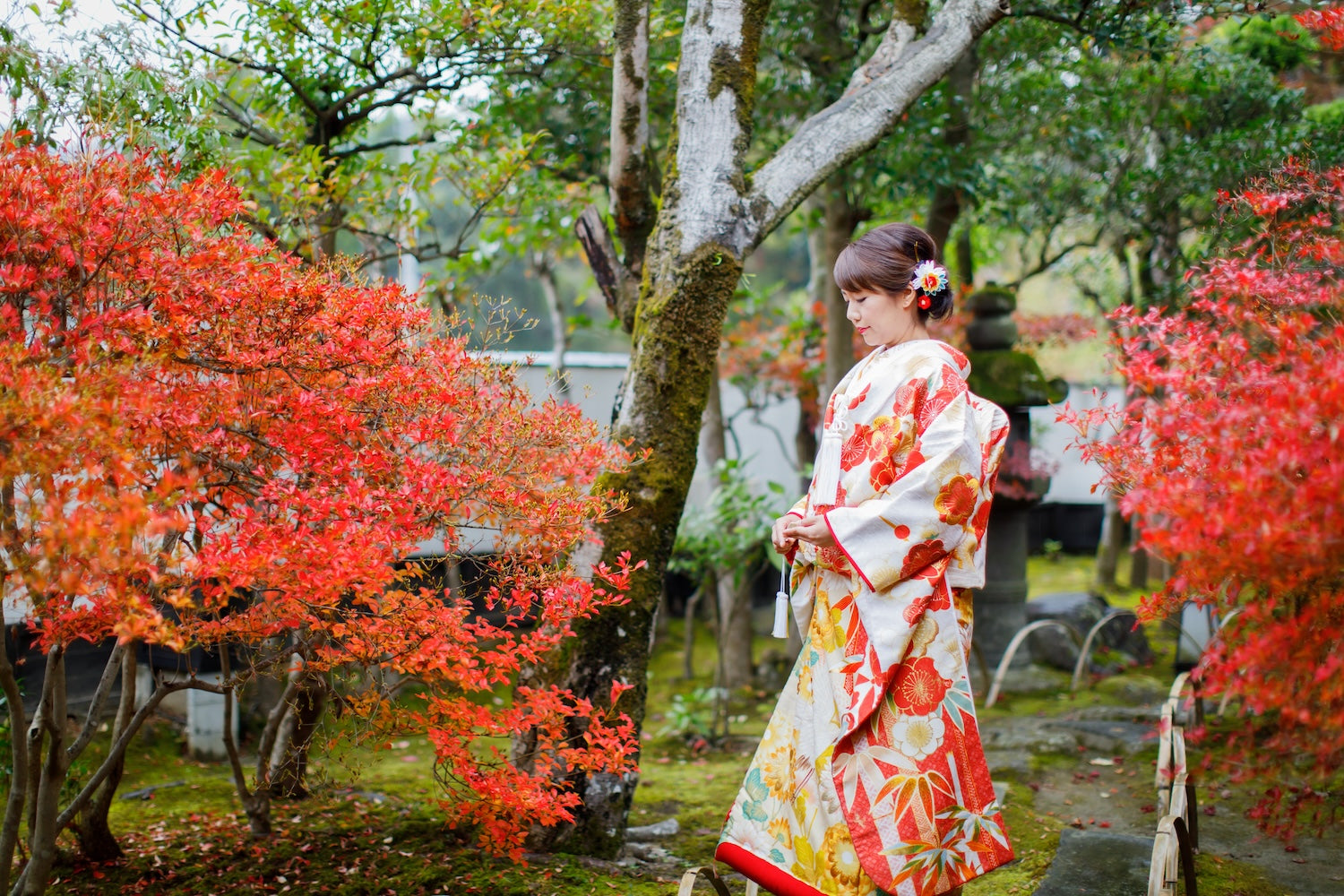
In short: WAKON STYLE asks you to consult in advance if your height is above about 195cm (6'5") or your bust, waist, or hip measurement is above about 120cm (47") — these are consultation thresholds, not published maximums. Beyond them, additional fees may apply, or the team may have difficulty accommodating your size, so early consultation matters. If a custom-sized garment turns out to be necessary, that requires special ordering and costs about 220,000 yen extra. Undergarments and everyday accessories are already included in the standard package, and a fitting can be arranged in advance, but the possibility of additional fees and the cost of a custom order are the two things to plan around rather than assume away.
If you are taller than average, broader than a standard pattern, or simply unsure how traditional Japanese wedding attire is sized, it is a reasonable thing to worry about before booking a wedding on the other side of the world. Search results and forum threads on this topic tend to land on one of two extremes: reassurance that "kimonos suit everyone," or vague warnings that overlook the details. Neither is complete enough to plan a trip around.
This guide sets out what WAKON STYLE actually publishes about sizing, drawing on the Important Information Before Booking page and the FAQ: the standard range, what happens above it, what measurements are collected and why, and what is already included versus what costs extra. It does not cover what to wear or whether to rent versus buy, which our guide on what to wear to a Shinto wedding already handles, or the broader Shinto wedding planning process. This one is about whether the attire will actually fit your body.
Table of Contents
- Will a Japanese wedding kimono fit me?
- What are the standard size limits?
- What happens if you're outside those measurements?
- What measurements do you need to provide?
- Can you try on the attire before the day?
- What's included, and what costs extra?
- FAQ: sizing and attire for your Shinto wedding
- Who supervised this guide?
Will a Japanese wedding kimono fit me?
For most people, yes. WAKON STYLE offers standard sizes built to accommodate a wide range of bodies, with a clear limit: for individuals taller than about 195cm (6'5"), or with bust, waist, or hip measurements exceeding about 120cm (47"), additional fees may apply, or the team may have difficulty accommodating your size. Anyone in that range is asked to consult in advance rather than assume the standard offering will work.
That second outcome is not simply "you'll pay more." It is "we may not be able to fit you," stated plainly alongside the reassurance that traditional attire suits most body types. Both things are true at once, and a responsible answer to "will it fit me" has to hold both. If your measurements are comfortably within the range, this is genuinely good news and the rest of this guide is mostly about logistics. If you are close to or beyond the range, the rest of this guide is about what to do next, starting now rather than after you land in Japan.
What are the standard size limits?
The two published thresholds are height and body measurements, and either one on its own is enough to put you outside the standard range.

| Measurement | Threshold above which WAKON STYLE asks you to consult first |
|---|---|
| Height | About 195cm (approximately 6'5") |
| Bust, waist, or hip | About 120cm (approximately 47") each |
These are the points at which WAKON STYLE asks you to get in touch, not a guarantee that everything below them is covered by a standard garment. Fit still depends on your particular combination of measurements, which is why the sizing details in the next section are collected before anything is confirmed.
Note that it is an "or," not an "and." Someone within the height limit but above 120cm on any one of bust, waist, or hip measurements is treated the same way as someone taller than 195cm: additional fees may apply, or accommodating the size may be difficult. There is no published breakdown of how close to these thresholds becomes a problem in practice, so the honest answer is that anyone near either number should raise it directly with WAKON STYLE rather than guess.
What happens if you're outside those measurements?
Two things, and it is important to hold onto both rather than pick the more comfortable one. First, additional fees may apply. Second, and separately, the team may simply have difficulty accommodating your size at all. That second possibility is not a formality. It means that, for some combinations of height and measurements, a fitting garment may not be readily available even at extra cost, which is precisely why WAKON STYLE asks people in this situation to consult in advance rather than book first and sort it out later.
Where a custom fit is possible, WAKON STYLE is specific about the cost: custom-sized attire requires special ordering and costs about 220,000 yen extra. That is not a vague premium, and it is not folded into a wider range of package prices; it is a distinct, published figure attached specifically to the situation where a standard garment will not do. A couple who only registers "extra fees might apply" and never sees the actual number can be caught off guard by a charge on that scale after arriving in Japan — which is the exact outcome this article exists to prevent.
Special ordering also takes time, in the same way that any made-to-measure garment does. If your height or measurements put you near or beyond the published thresholds, the practical move is to raise it during your early consultation, well before you are locking in flights, rather than discovering the issue once you are finalizing your wedding-day details.
What measurements do you need to provide?
The measurements WAKON STYLE asks for depend on which attire you are wearing, since a shiromuku or iro-uchikake is fitted differently from a montsuki hakama.

| Attire | Measurements requested |
|---|---|
| Shiromuku or iro-uchikake | Weight, height, foot size, waist, bust |
| Montsuki and hakama | Weight, height, foot size, waist, chest, length from hip to ankle |
Alongside these figures, WAKON STYLE also asks for a full-body photo. If sending a photo of yourself to a wedding vendor overseas feels like an odd request, the purpose is narrow: a simple smartphone snapshot is enough, and it is used solely to recommend attire that complements your figure. It is not used for anything beyond attire selection, and a casual photo is explicitly enough — there is no need to arrange a professional shoot just to submit measurements.
Providing accurate figures here, rather than rounded or approximate ones, is what allows the team to flag a possible sizing issue early, while there is still time to discuss a custom order if one turns out to be necessary.
Can you try on the attire before the day?
Yes. A fitting can be arranged in Japan by advance reservation. It is conducted in Japanese and no interpreter is provided. It must take place more than three weeks before the ceremony so there is time for any required maintenance. If you are deciding whether an advance visit is worthwhile, our guide on whether you need to visit Japan before your wedding explains what can and cannot be settled remotely.

Attire is generally reserved one to three months before the ceremony, with the exact timing confirmed for the selected garment. Popular one-of-a-kind items are worth reserving early. If you are also wearing a tsunokakushi, its semi-custom wig requires a separate head-size fitting at least two weeks before the ceremony. Our booking timeline guide puts these dates in order.
What's included, and what costs extra?
The reassuring part first: all necessary undergarments and accessories for traditional Japanese attire are included in the basic package. You are not expected to source anything separately to make the standard outfit complete, and the attire itself is rental only — WAKON STYLE does not sell wedding garments, so there is no purchase decision to make on top of the sizing question.
Where costs start to layer on is at the optional end of the range, and it is worth seeing the actual figures rather than a rounded estimate:
| Item | Cost |
|---|---|
| Bride's premium attire options | From 10,000 yen |
| Bride's second outfit | Additional fee (amount varies) |
| Groom's hair and makeup (not usually included) | 11,000 yen (tax included) |
| Watabōshi rental | 11,000 yen |
| Tsunokakushi rental (includes wig) | 27,500 yen |
| High-grade optional accessories | Additional fee (amount varies) |
| Custom-sized attire (special order) | About 220,000 yen extra |
On the attire side specifically, many couples choose upgrade options adding around 100,000 yen. That figure and the ones in the table above are individual costs published for individual choices; they are not meant to be added together into a single total, since which of them apply depends entirely on what you select.
FAQ: sizing and attire for your Shinto wedding
Two questions here are about bringing your own items rather than sizing.
Can I bring my own wedding attire from home? Policies vary by shrine, so this needs to be discussed in advance for your specific venue rather than assumed to be allowed everywhere.
Can I bring my own hair accessories? Yes, as long as the design suits traditional Japanese attire and the piece can be securely fastened, for example with wires or combs.

Who supervised this guide?
Supervised by Etsuko Inoue, WAKON Wedding Producer
View Etsuko Inoue's full profileEtsuko Inoue has produced international Shinto weddings since 2017. Her profile shares more about her background and how she works with couples planning a wedding in Japan.
If your height or measurements are close to the ranges described above, contact WAKON STYLE with your figures before you book, so the team can confirm what's possible and flag any special ordering while there's still time to plan around it.
Contact Us

