


Etsu (Etsuko) Inoue

ABOUT ETSUKO
Etsu (Etsuko) Inoue, Our WAKON Wedding Producer
Based in Fukuoka, she travels to shrines across Kyushu and Kansai. From the first email to the final bow on the day, she stays beside you — through shrine selection, attire fittings, every meeting in between, and interpretation inside the inner hall.
Since 2017, she has produced more than a hundred international weddings.

Before WAKON STYLE
Then came Canada — first to study English, later to work for a Japanese travel company in Vancouver. After 9/11, when the travel industry shifted, friends began asking me to coordinate their weddings. From those requests, I built a small business of my own, planning ceremonies in hotels, on golf courses, in wineries. I earned bridal certifications from both the United States and Canada.
Through those years, I was also working as an artist — floral design, paper goods, wedding decoration.
In 2017, I came home to Japan and joined WAKON STYLE.
A Shinto wedding rests on faith — Shinto is a religion. The couples I had welcomed in Canada, too, had held their ceremonies on the faith they carried. That overlap, for me, mattered more than anything.
Everything I had done until then turned out, in the end, to be the ground I now stand on.
Couples We Have Welcomed
Here, with their kind permission, are some of the couples we have welcomed from overseas.


A Bride Who Sang to the Gods
I always send the shrine, in advance, a few notes about the couple — where they are from, what they do, what brought them to Japan. Some shrines use these notes in the closing words of the ceremony.
This couple were musicians, living in the United States. The groom, an amateur guitarist. The bride, a semi-professional singer and saxophonist. Between their day jobs, the two of them played concerts together, and she sang in clubs. She loved the fashion and music of 1950s and '60s America, and posted about it often online. Both had taught themselves Japanese — she could even sing along to famous Japanese singers.
It was their first time in Japan, and they had long dreamed of a traditional Shinto wedding here. Before the ceremony, I told the priest a little about them — where they were from, that one played guitar, the other sang.
On the day, under a clear autumn sky, it was a ceremony for the two of them alone. After the groom was dressed and standing ready, the bride came up quietly behind him and tapped his shoulder. When he turned and saw her, he was, for a moment, entirely without words. "Turn around for me," I told her — and he watched her turn, and could not stop looking.
The ceremony itself was solemn, and unfolded quietly inside the main hall. After the closing words, the priest turned toward us, and said:
"Would you sing for us? Here, before the gods."
I translated, thinking at first he was joking. He was not.
The bride asked if she should warm up her voice first. "You'll be fine," I told her. She sang Elvis Presley, a cappella, inside the main hall.
I have never seen this at any other shrine.
Her Instagram still carries photographs from that day, and she keeps posting scenes from Shinto weddings even now — something of an influencer for WAKON STYLE. Their second life, they told me, began here.


The Wedding She Didn't Know About
A couple from Brazil, marking their wedding anniversary with a family trip through Japan — their two children in tow. For the bride, the whole thing was a secret: a Shinto ceremony in Kyoto, planned by her husband, and kept from her until the day itself.
It was their first time in Japan. December, in Kyoto: outside, the city was busy with the year's end. Inside the shrine, everything was still.
Their son and daughter wore kimono for the first time. So did the bride — and she could barely contain her excitement.
Once she was dressed, I brought the groom to the Noh stage for what has become, for me, a usual moment: the first look. He kept trying to peek into the room before she was ready. I sent him back out, more than once.
Then, at last, he saw her. Even after all their years together, he was moved all over again.
We took the family photographs. Then the ceremony began — solemn, quiet, their two children watching.
They had ordered a video of the day. At the end of it, a surprise: a message from their children.
"We love you, Mom and Dad. Stay happy, always."


The Third Country
The first couple from Brazil we had ever welcomed at WAKON STYLE. They loved Japan already — even the two cats they kept carried Japanese names, Haru and Mochi.
They had married legally back home in Brazil, and from there a journey began: a honeymoon that was also a series of wedding ceremonies, just the two of them. In Brazil there had been a ceremony and reception at a hotel with a view of the sea, family and friends gathered — the groom in a white suit, the bride in an elegant white trouser suit, her bouquet a natural white and green. Then Las Vegas, and a drive-through wedding. A ceremony at a small chapel. And then the third country: Japan, the one they had longed for.
Choosing a shrine took a great deal of time. Candidates came up in Tokyo and in Kyoto, and I introduced one after another, but nothing was quite it. What they wanted was a shrine that still held Japan's old traditions, without many visitors. Toyokuni Shrine in Kyoto was the one they said matched the image they carried, and that is where they decided. They loved Japan enough to choose it as the place where this series of weddings would end.
The bride works in hair and beauty, and came to every meeting with a stylish color in her hair. When they asked what the traditional attire would be and I answered shiromuku, that is what she chose — an embroidered, classical design.
At our meetings they asked me the same question every time, about the attire, about how to carry themselves, even about how to wear their hair: would this be disrespectful to the shrine? They are people who honor the traditions and the culture of the country they are in.
The day came. Kyoto was still somewhat cold — spring, but the cherry blossoms had not opened. While she was getting ready, she was full of curiosity about the makeup and the attire; even slipping on the nagajuban alone moved her. At the shrine, the great torii and the National Treasure karamon gate overwhelmed them both. Then out into the grounds: they enjoyed the photographs in the garden, and at the rehearsal the two of them practiced their vows together in Japanese. At the end, the shrine offered them kombucha tea. Neither had tasted it before. Both drank it down to the last drop.
Then the ceremony began. Past the approach, the main sanctuary opened up before us, and the rite was held in the worship hall, with three musicians playing gagaku — a ceremony for the two of them alone. Watching how they carried themselves through the san-san-kudo and the tamagushi offering, I was moved: more Japanese, I thought, than Japanese people.
They made their marriage vows in the Shinto way, Japan's own traditional religion. It had been their dream for a long time.
When the ceremony closed we photographed a little more in the grounds — and the posing was pure Latino. They talk well, laughter never stopped, they dress with style, and they are moved by, and grateful for, everything.
A year later, a son was born to them. Toyokuni Shrine enshrines Toyotomi Hideyoshi, and is known for blessings of success and advancement, of good matches, of long life. When the child was born the groom contacted me: they had named him Kai, after Japan. He asked what families in Japan do when a child is born. I told him about omiyamairi, the visit families make to a shrine after a birth — and said that since they live so far away, they should come to Toyokuni Shrine as three, once he is a little older.
Perhaps the bond, and the child they were given, were blessings of Toyokuni Shrine too.


Watched Over by the Kannon
They asked for the Kyoto area, sometime in March or April. When we spoke online, the shrines in Kyoto did not match the image they carried, so I introduced Hasedera, in Nara — and at once they decided on a Buddhist wedding there.
Shrines in Japan are familiar enough to people from abroad. A Buddhist ceremony at a temple, though — my sense is that almost no one has a picture of it. It differs greatly from a Shinto rite. When I explained those differences carefully, I think they came to understand better what a temple wedding could be. Still, all they had was photographs and video. They had not felt the temple's scale, or the air of the place. They were holding an image built only from imagination.
Hasedera is famous — almost too famous — as the Temple of Flowers. Their date fell just after the cherry blossoms had finished, when the peonies and the green maples were at their most beautiful.
The temple is the head temple of the Shingon Buzan school. The ceremony is held in the main hall, a National Treasure. The principal image is a standing eleven-headed Kannon: wooden, 10.18 meters tall, one of the largest wooden Buddhist statues in Japan. To be watched over by this Kannon matched what they had hoped for — and the day went beyond what they had imagined.
While she was getting ready, the bride took out a small piece of cloth. This, she said, is a cloth I remember from when I was small, from my time with my mother. I tucked it into the breast of her kimono. I did not ask further. There was a memory of her mother from childhood there, I imagine.
Once she was ready came the first look, as always — the moment they see each other, a surprise from me. Seeing how radiant she was, the groom was overcome.
Then photographs in the wide grounds — there are many spots for it. What I wanted above all was a shot with the peonies behind them, and I asked the photographer for it. She had deliberately chosen an orange-gold iro-uchikake, precisely because this was a temple: a coordination that shone against both the temple and the scenery around it.
After a short rehearsal, we moved to the stage. On it, only the two of them and the monks — and then the ajari appeared, and the Buddhist rite began. The body is purified with scented powder, and the ceremony starts. Then the ajari's admonition, spoken to the two of them. At Hasedera there is the conferring of a kesa and juzu prayer beads. They read their vows well, in Japanese, and what corresponds to the san-san-kudo was performed with sweet amacha tea. At the close, all the monks chanted the Heart Sutra together, and it resounded through the main hall and through the grounds.
When the ceremony closed, we photographed them on the stage, wearing the kesa and the juzu, with Kobo Daishi watching over them behind. A deeply mysterious wedding, at a temple — the moment when their wonderful future began, there on that stage.
Always smiling, treating everything with respect, their hands pressed together in prayer: that is what stayed with me.


FROM ETSUKO
Four Things I'd Like to Share with You
Four things I'd like to share with you — about the ceremony itself, about the gods who welcome you, about how a shrine is chosen, and about the many hands that, on the day, hold everything together.
-

i. About the Vows You Will Read
In a Shinto wedding, you read the vows aloud yourself. About ninety seconds. In Japanese. Before the gods.
The words you read aloud are the heart of the ceremony. Without them, the wedding is not complete.
The shrine sends us a sample text in advance. We add romanized readings beside the Japanese, and we rehearse together until you can read it through, in your own voice.
Every couple I have welcomed has done this. -

ii. About the Gods Who Welcome You
Couples often ask me: "Shinto is a Japanese religion. We have a faith of our own. Is it really all right for us to be married this way?"
Shinto does not center on a single god. The mountains, the rivers, the forests, the sea — all of nature is held to be sacred, and the gods dwell in all of it.
So a faith of your own is no obstacle to a Shinto wedding.
Many of the couples I have welcomed grew up close to nature, in their own way. That feeling and the way Shinto sees the world share the same root. -

iii. About How a Shrine Is Chosen
When you first write to us, I ask two things: the area you have in mind, and when. The shrine is chosen from there.
Some couples come with a shrine already in mind; others are starting from zero. Either way, we decide it together, in conversation.
When I select a shrine, I weigh two things: that the shrine itself is beautiful — enough for the photographs you will carry home — and that the ceremony can be held quietly and privately, away from crowds.
For couples still deciding, I narrow the many shrines we have come to work with down to two that meet these conditions. From there, you choose.
I have chosen shrines this way for years. And whether or not the name was famous, couples tell me afterward, again and again, that they were glad it was that shrine. -

iv. About the Many Hands Behind the Day
From the first conversation to the day itself, I do not work alone.
On the day, beside the couple, are the dressers, hair-and-makeup artists, and photographers who have worked with me for years. They know how I run a day before I say a word.
The shrines, too, have come to know us well. They welcome couples from overseas warmly — and some, now, offer on their own what they would not normally allow, such as photographs inside the inner hall.
It is with the help of all these people that my work exists at all. So please — leave the day to us, with confidence.


If You Are Thinking About a Wedding in Japan
There is no other wedding like this anywhere in the world.
It takes place inside a shrine that has stood in this country for centuries. The rites are performed in Japanese — a language most of you will not understand a single word of.
And yet, what couples tell me afterward is never about the words. What stayed with them was the air. The quiet. The music. The shrine itself.
This is a day you will have only once.
If something in it draws you, please write to me. Before anything is decided, let us begin with a single conversation. Bring your questions — that is enough. There is no commitment.
I am here.
-

Japanese Wedding Ceremony Plan
Ideal for couples wanting an authentic Japanese wedding ceremony at a shrine or temple.
-
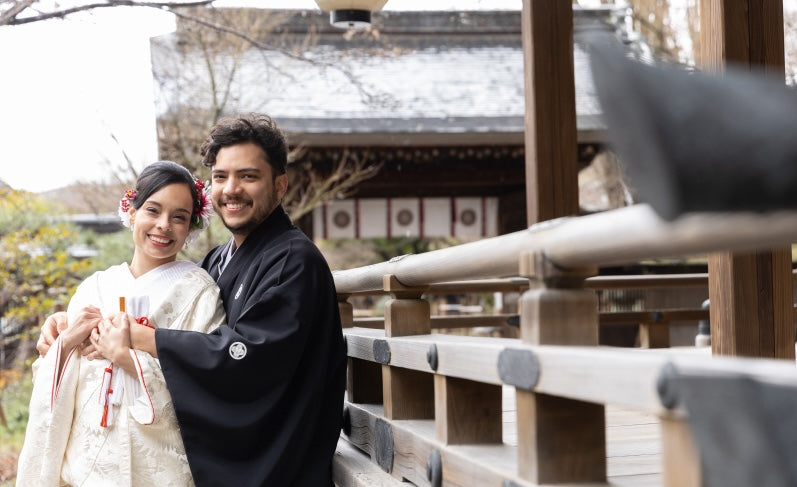
Japanese Wedding Ceremony + Photo Plan
Ideal for couples wanting a Japanese wedding ceremony with a full photo shoot.
-

Japanese Wedding Ceremony + Two Bridal Outfits + Photo Plan
Ideal for couples wanting a Japanese wedding ceremony with two traditional outfits and a full photo shoot.


Frequently Asked Questions
-
Are the wedding planners male or female? And how many planners will be supporting us?
-
Do you provide support for LGBTQ couples as well?
-
Do you offer hair and makeup services?
-
What should we be careful about when preparing from our home country?
-
Could you tell me about the necessary documents and procedures?