Real Wedding Story
01


Article: Shrine or Temple: Which Should You Choose for Your Japanese Wedding?
In short: Most couples searching for a Japanese wedding are picturing a Shinto ceremony at a shrine, and that remains the focus of WAKON STYLE's service. But a temple wedding is also available, and the two are not the same thing dressed differently. At a shrine, couples make vows to Shinto gods, honoring nature and ancestral deities. At a temple, vows are based on Buddhist teachings, made to Buddha and ancestors. WAKON STYLE supports selection and booking for both, and the ceremony fees currently listed on its site run from about 60,000 to 200,000 yen overall. That list is a partial one rather than every venue available, so treat it as a guide to individual venues rather than to what shrines or temples cost as categories.
If you arrived here searching for a "Shinto wedding in Japan," you are looking for a shrine ceremony, and that is exactly what most of this site is built around. But partway through planning, some couples come across the word "temple" and are not sure whether it belongs in the same conversation or a completely different one. It does belong in the same conversation. A temple wedding is a real, bookable option alongside a shrine wedding, and understanding the difference helps you choose with intention rather than by accident.
This guide starts from the one explanation already published on WAKON STYLE's Shinto wedding overview, expands it into something you can actually use to decide, and points you to fee information, a note on temple lodging, and the questions worth asking before you book either kind of venue.
At a shrine, couples make vows to Shinto gods, honoring nature and ancestral deities. At a temple, vows are based on Buddhist teachings, made to Buddha and ancestors. That single distinction, published directly on WAKON STYLE's site, is the starting point for everything else in this guide.
Both offer a sacred, solemn atmosphere, and the choice is one couples can base on their own beliefs or family traditions, with either option providing a meaningful start to married life. WAKON STYLE does not rank one above the other, and neither does this guide.
What matters practically is this: WAKON STYLE's support covers venue selection and booking for both shrines and temples, so choosing a temple does not mean stepping outside what the service offers. It means choosing a different kind of venue within the same process. If a Shinto shrine ceremony is what you had in mind when you started researching, the rest of this site — including our guide on what a Shinto wedding ceremony actually involves — remains the right place to keep reading. This particular guide exists so that the word "temple," if you encounter it while planning, does not derail that research.
A shrine ceremony is the version most couples are picturing, and it remains the core of what WAKON STYLE arranges. The vows are made to Shinto gods, in a setting built around nature and ancestral reverence, and the format is the one most commonly associated with a "traditional Japanese wedding."

This guide does not walk through the ceremony step by step, because that would duplicate ground already covered elsewhere. If you want to understand what actually happens during a shrine ceremony, from the procession into the shrine grounds through to the closing moments, our dedicated guide on what actually happens at a Shinto wedding covers it in full. What matters here is simply that a shrine wedding is not the only structure available through the same service, and the rest of this article is about the alternative.
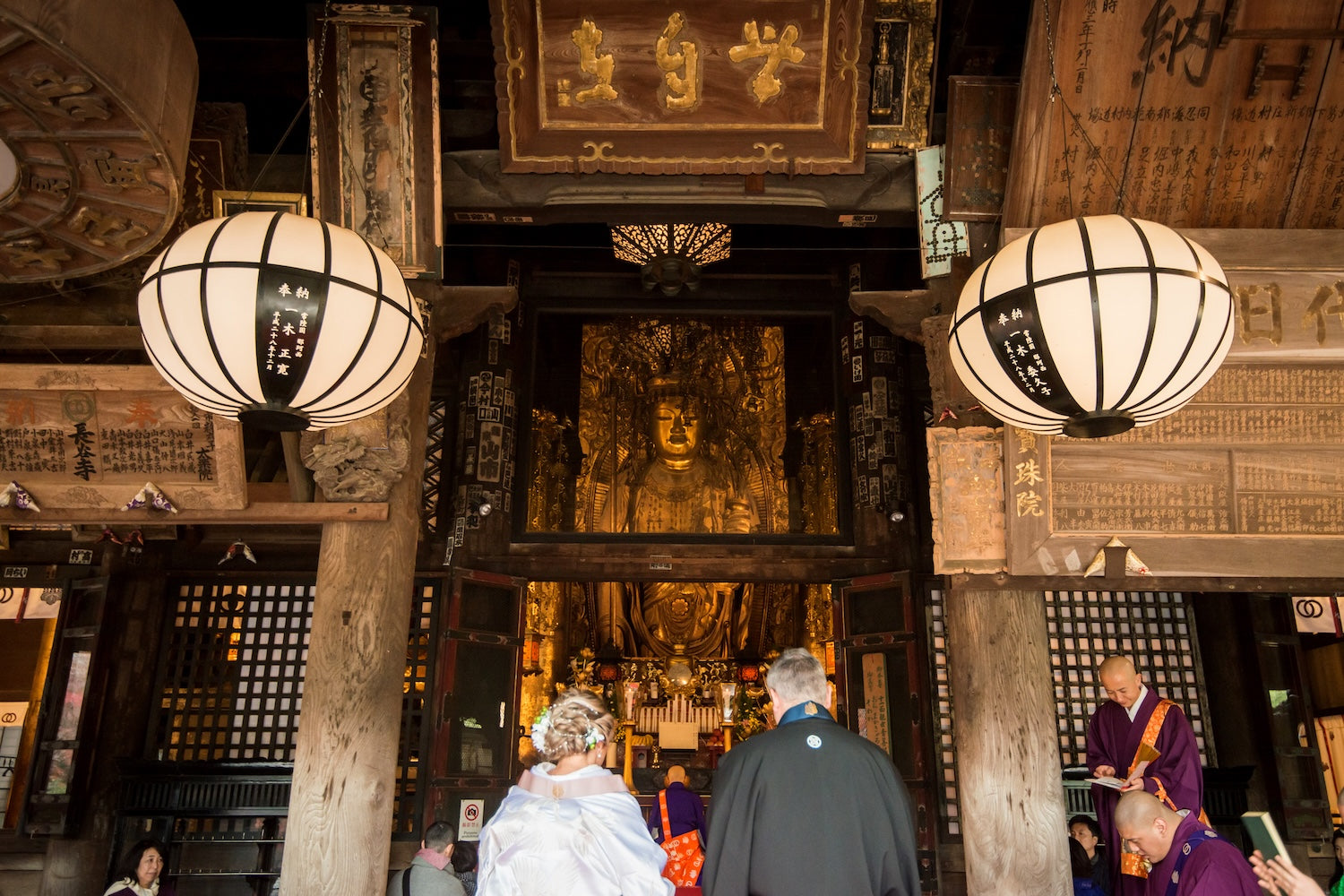
The vows are based on Buddhist teachings rather than Shinto ones, made to Buddha and to ancestors instead of to Shinto gods. Beyond that distinction, this guide deliberately does not go into the doctrinal or sectarian differences between temples, since that level of detail is not necessary for deciding whether a temple ceremony suits you, and getting it wrong would do more harm than leaving it out.

WAKON STYLE's FAQ is explicit that ceremony details vary from shrine to shrine. It does not make the same statement specifically about temples, but there is no published reason to expect temples to be more uniform, so the practical advice is the same either way: ask questions about your specific venue rather than assume the format is fixed, whether you are comparing two shrines or two temples.
Across the venues currently published on WAKON STYLE's site, ceremony fees run from about 60,000 to 200,000 yen. Within that published sample the four temples sit at the upper end, from 150,000 yen, while the nine shrines sit between 60,000 and 110,000 yen. That is a description of thirteen listed venues, not a price rule for either type, and the sample is too small and too partial to treat as one.
| Area | Venue | Type | Ceremony fee |
|---|---|---|---|
| Kyoto | Hasedera Temple | Temple | 150,000 yen~ |
| Kyoto | Nashinoki Shrine | Shrine | 80,000 yen~ |
| Kyoto | Nishi Hongwanji Temple | Temple | 150,000 yen~ |
| Kyoto | Oharano Shrine | Shrine | 85,000 yen~ |
| Tokyo | Nakano Numabukuro Hikawa Shrine | Shrine | 85,000 yen~ |
| Tokyo | Nanasha Shrine | Shrine | 70,000 yen~ |
| Tokyo | Saimyoji Temple | Temple | 200,000 yen~ |
| Tokyo | Yushima Tenmangu | Shrine | 100,000 yen~ |
| Fukuoka | Kamado Shrine | Shrine | 100,000 yen~ |
| Fukuoka | Kashii Shrine | Shrine | 70,000 yen~ |
| Fukuoka | Sumiyoshi Shrine | Shrine | 60,000 yen~ |
| Wakayama | Koyasan Eko-in Temple | Temple | 200,000 yen~ |
| Wakayama | Kumano Hongu Taisha | Shrine | 110,000 yen |
A few things are worth reading carefully in this table before drawing conclusions from it. It is a partial listing, not a complete one: each region page links through to a full list of shrines for that area, so more venues exist than are shown above. Four temples against nine shrines is not enough to establish what either type costs in general, and the four temples that happen to be listed are all in Kyoto, Tokyo, and Wakayama rather than spread evenly. So the pattern in this table is worth noticing when you compare specific venues, and worth ignoring as a rule about temples and shrines as categories. The reliable takeaway is the overall range and the fact that it is worth asking about your specific venue.
Any figure beyond the ceremony fee, including a total cost for the wedding once attire, photography, and other options are added, is a separate question.
One, clearly: some temples offer a "shukubo" experience, an overnight stay on the temple grounds. Shrines typically do not have accommodation facilities at all.

A shukubo stay is offered at some temples, not all of them, and not as a standard inclusion across every temple booking. If staying overnight at the ceremony venue itself is something you would value, it is worth raising directly when discussing venue options, rather than assuming any temple you choose will include it.
Start with what already feels right to you, then use the practical differences to confirm the decision rather than to make it. A few factors are worth weighing side by side.
The atmosphere and symbolism come first, since they are the actual substance of the choice: Shinto vows made to nature and ancestral deities at a shrine, or Buddhist vows made to Buddha and ancestors at a temple. Your own beliefs, or your family's traditions, are a legitimate basis for choosing either one, and WAKON STYLE does not present one option as more "authentic" than the other. If the question behind this one is whether you need to hold either faith yourself in order to marry at a shrine or a temple, that is a separate question with its own answer, and our guide on whether you have to be religious to have a Shinto wedding addresses it directly.
After that, location and the venue's own character matter, since shrines and temples are found in different areas and each has its own setting and grounds. Ceremony fees are worth comparing once you have a shortlist, understanding that the range runs from about 60,000 to 200,000 yen across both venue types rather than splitting cleanly by category. And if an overnight stay at the venue itself appeals to you, that points toward asking about shukubo availability at specific temples rather than assuming it is available everywhere.
Narrowing down an actual shrine, once you know that is the direction you want, is its own process with its own considerations around location, size, and character. Our guide on how to choose a shrine covers that step in detail and picks up where this guide leaves off.
Two things, and both apply regardless of whether you choose a shrine or a temple. First, only a limited selection of venues is available for reservation through WAKON STYLE. If you are set on a specific shrine or temple, it is worth confirming early whether it is one WAKON STYLE can book on your behalf, rather than assuming any venue you find independently is reachable through the service.
Second, the proceedings and specific ritual details of the ceremony can vary from venue to venue. WAKON STYLE's FAQ states this directly for shrines; the site does not make the same statement specifically for temples, but there is no published reason to expect otherwise, so a description of "how the ceremony works" at one shrine should not be assumed to transfer exactly to another, and the same caution is worth applying to temples even without a direct statement on the site.
Venue selection itself is part of what WAKON STYLE's core package covers. The Shinto Wedding Package includes shrine and temple selection and booking as one of its listed components, alongside attire, styling, and interpretation support — so once you have a general direction in mind, the process of finding and securing a specific venue is handled as part of the same service rather than something you need to arrange separately. Details on eligible venues and booking conditions are set out on the Important Information Before Booking page, and the FAQ covers a number of related questions that come up once a venue type is chosen.

Supervised by Etsuko Inoue, WAKON Wedding Producer
View Etsuko Inoue's full profileEtsuko Inoue has produced international Shinto weddings since 2017. Her profile shares more about her background and how she works with couples planning a wedding in Japan.
If you are weighing a shrine against a temple for your own ceremony, contact WAKON STYLE with what matters most to you, and we can talk through which venues fit.
Contact UsReal Couples, Real Experiences
Explore more real Shinto and Buddhist wedding experiences in Japan.