

How Many Days Do You Need in Japan for a Shinto Wedding? A Realistic Trip Plan
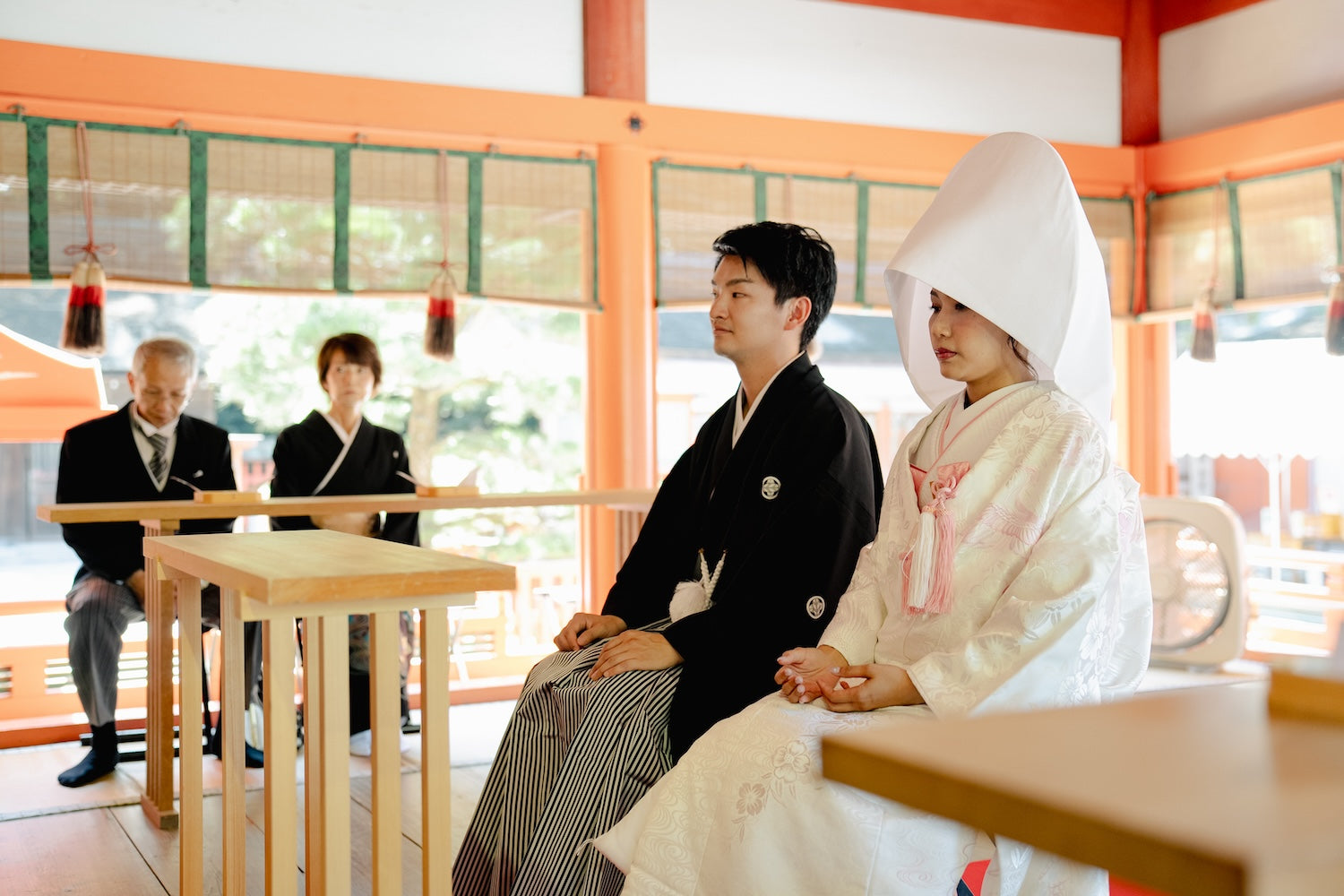
In short: There is no single fixed number of days, but two points are fixed. WAKON STYLE recommends arriving in Japan at least two days before your ceremony, and specifically advises against arriving the day before. And the wedding day itself is longer than most couples expect: a published sample schedule runs from 8:45 in the morning to 13:10, roughly four and a half hours, even though the ceremony is only about thirty minutes. Everything else, including sightseeing, a post-ceremony photo session, or time with family, is built around those two points.
Almost every couple planning a Shinto wedding from abroad hits the same problem in the same order. You settle on the idea, you start looking at shrines, and then you open a flight search and realise you cannot book anything until you know how long you need to be in Japan. The information that is easiest to find is that a Shinto ceremony lasts about thirty minutes, which is accurate but, taken on its own, badly misleading as a basis for planning a trip.
This guide sets out the two parts of the trip that are not flexible, shows what the wedding day actually looks like from arrival to conclusion, and then explains what you would be adding days for. It deliberately stops short of telling you that you need a specific number of nights, because that depends on choices only you can make. What it should give you is enough structure to book flights with confidence rather than guesswork.
Table of Contents
- How many days do you need in Japan for a Shinto wedding?
- Why should you arrive at least two days before the ceremony?
- What does the wedding day actually look like, hour by hour?
- Where do you get dressed on the wedding day?
- What can you add before and after the ceremony?
- How should you build the rest of the trip around it?
- Who supervised this guide?
How many days do you need in Japan for a Shinto wedding?
There is no single correct answer, but two parts of the trip are effectively fixed: WAKON STYLE recommends arriving in Japan at least two days before the wedding day, and the wedding day itself runs from 8:45 to 13:10 in a published sample schedule. Treat that day as a full commitment rather than a morning appointment.
It helps to stop thinking about a total number of nights and think instead about three blocks that stack on top of each other. The first two have a shape that is already determined; the third is entirely yours.
| Part of the trip | What it covers | How long |
|---|---|---|
| Arrival buffer | Landing, recovering from the flight, absorbing any delay | At least two days before the wedding day |
| The wedding day | Preparation, dressing, photography, the ceremony itself, commemorative photos | Around four and a half hours in the published sample schedule, though this varies |
| Everything you add | A shrine visit beforehand, a post-ceremony photo session, a meal with guests, sightseeing, a honeymoon | Entirely your choice |
Reading it this way avoids the trap that catches most couples. The ceremony is short, so it is tempting to slot it into a trip you had already planned for other reasons and assume the day is free by lunchtime. In practice the ceremony is the brief part of a long morning, and the day before the ceremony is not a day you want to spend in the air.
If you have not yet decided when in the year to come, or how far ahead to lock the date in, those questions come before this one. Our companion guides on the best time of year for a Shinto wedding and how far in advance to book cover those decisions, and this guide assumes you already have a rough date in mind.
Why should you arrive at least two days before the ceremony?
Because WAKON STYLE explicitly recommends it. We advise planning your schedule with ample time, avoiding arrival the day before the ceremony, and allowing for potential problems such as flight delays by arriving in Japan at least two days before your wedding day.

That recommendation is worth taking at face value. A delayed connection, a missed bag, or a long-haul flight that lands at the wrong end of the day are all recoverable if there is a spare day in the schedule and not recoverable at all if there is not. The wedding date is fixed around a shrine's own booking, so it is the one part of the trip that cannot absorb a change of plan.
There is also a less obvious reason. The morning of a Shinto wedding starts early and involves several hours of dressing, hair, and makeup before the ceremony begins. Doing that on the back of an overnight flight, in an unfamiliar time zone, is not how you want to remember it.
You do not have to work out the exact times yourself. Once your booking is finalised, WAKON STYLE prepares a detailed timeline for the day covering the meeting time, travel to the shrine, when the ceremony starts, and when photographs are taken. The steps leading up to that point are set out on the Steps to Shinto Wedding page.
What does the wedding day actually look like, hour by hour?
Longer than the ceremony alone suggests. WAKON STYLE publishes a sample schedule that runs from 8:45 to 13:10, around four hours and twenty-five minutes in total, with the ceremony occupying roughly thirty minutes of that.

| Time | What happens |
|---|---|
| 8:45 | Arrival |
| 8:50 | Preparation begins |
| 11:00 | Photo session starts |
| 12:00 | Ceremony begins |
| 12:30 | Commemorative photos |
| 13:10 | Conclusion |
This is a sample, not a fixed timetable. Times vary based on the shrine and the booking status, so treat the shape as indicative and wait for your own timeline before booking anything else on the same day.
What the shape tells you is where the time actually goes. More than two hours pass between arrival and the start of the photo session, and the ceremony does not begin until midday. That morning window is not broken down step by step here, because inventing a breakdown would be misleading. What is confirmed separately is that hairstyling alone typically takes about thirty to forty minutes, and that dressing in traditional attire along with hair and makeup are all handled by the team on the day. The useful conclusion is not the internal split but the total: the ceremony is the short part of a long morning.
The ceremony itself usually lasts about thirty minutes, and what happens inside those thirty minutes, from the procession to the shrine's inner hall through to the exchange of sake cups, is covered in detail in our guide to what actually happens at a Shinto wedding. This guide stays outside the ceremony and deals with the day around it.
Three pieces of practical advice for the day come directly from WAKON STYLE. Have a light meal beforehand, since the gap between the morning start and the conclusion is long. Allow extra time rather than arriving exactly on the hour. And brides are asked to skip hair products and use basic skincare only, so that the stylist is working with clean hair on the day.
Where do you get dressed on the wedding day?
Not necessarily at the shrine. Facilities vary, but many shrines do not have changing rooms, so dressing is often completed elsewhere before arriving. Where a separate space is needed, additional fees of 22,000 yen or more may apply depending on the location.

This is one of the details that quietly shapes the morning. Most shrines have restrooms and powder rooms available, but a changing room is a different requirement, and its absence is common enough that WAKON STYLE addresses it directly. If the shrine you choose cannot accommodate dressing on site, the preparation happens at another location and you travel to the shrine already in traditional attire.
That travel does not have to be left to you, but it does have to be asked for. Taxi services can be arranged on request according to your needs, which matters more than it sounds: moving through a city in a shiromuku or a full montsuki haori hakama, with attendants and attire, is not a walk-to-the-station situation.
Where exactly you meet on the day is not something you need to resolve in advance. The published sample schedule lists an arrival time without specifying the venue, because that depends on the shrine and the arrangements made for your booking. It is confirmed in the detailed day-of timeline prepared after the booking is finalised, and the conditions that affect it are set out on the Important Information Before Booking page.
What can you add before and after the ceremony?
Three things, each of which affects how many days you need. A visit to the shrine before the wedding, a photo session at another location after the ceremony, and a meal with your guests are all possible, and none of them fit inside the sample schedule above.
An advance visit to the shrine is possible if you want one. Seeing the site in person helps you picture the day and makes the schedule easier to follow, though it is not required, and preparations can be completed without travelling to Japan in advance at all. Our guide on whether you need to visit Japan before your wedding covers what can and cannot be settled remotely.
A photo session at a traditional landscape or a well-known location after the ceremony is also possible, with WAKON STYLE handling the location selection and arrangements. Because of strict shrine rules, photography at the shrine itself must be handled by WAKON STYLE's own experienced photographers rather than a photographer you bring yourself; whether the same applies to a session away from the shrine grounds is worth confirming directly with WAKON STYLE. If a location session matters to you, it needs a slot in the day or a separate day entirely.
A meal after the ceremony works differently from a Western reception, and the difference surprises most couples. Depending on the ceremony location, WAKON STYLE can introduce Japanese and Western-style restaurants and banquet halls nearby. How that fits together, and what else follows the ceremony, is covered in our guide to what happens after a Shinto wedding.
How should you build the rest of the trip around it?
Start from the two fixed points, then decide what the trip is for. If it is a wedding trip and a first visit to Japan at the same time, the days on either side matter as much as the day itself, and it is worth choosing a base you actually want to spend time in.
Accommodation is one place where you do not have to work alone. WAKON STYLE can introduce hotels and recommended accommodations near the shrine, and for some hotels the entire process can be handled on your behalf. Staying close to the venue is worth more than it looks on a map once you factor in an early start in unfamiliar surroundings.
Four other decisions interact with the length of the trip, and each has its own guide.
The season changes what the day looks like and how far ahead you need to move, and it is the decision that usually comes first: the best time of year for a Shinto wedding sets out the trade-offs. How far ahead to start is covered in how far in advance to book a Shinto wedding, which lays the deadlines out on a single timeline. If family or friends are travelling with you, bringing family and guests to a Shinto wedding covers the arrangements that change once other people are involved.
For the ceremony itself and what WAKON STYLE's support covers, the Shinto wedding overview is the main reference, and the FAQ answers a number of smaller practical questions that come up once a date is set.

Who supervised this guide?
Supervised by Etsuko Inoue, WAKON Wedding Producer
View Etsuko Inoue's full profileEtsuko Inoue has produced international Shinto weddings since 2017. Her profile shares more about her background and how she works with couples planning a wedding in Japan.
If you are working out how long to stay and when to fly, contact WAKON STYLE with your preferred dates and the areas you are considering, and we can talk through what the day would look like for your plans.
Contact Us

