

Article: Same-Sex Shinto Weddings in Japan: What LGBTQ+ Couples Should Know Before They Ask
Same-Sex Shinto Weddings in Japan: What LGBTQ+ Couples Should Know Before They Ask
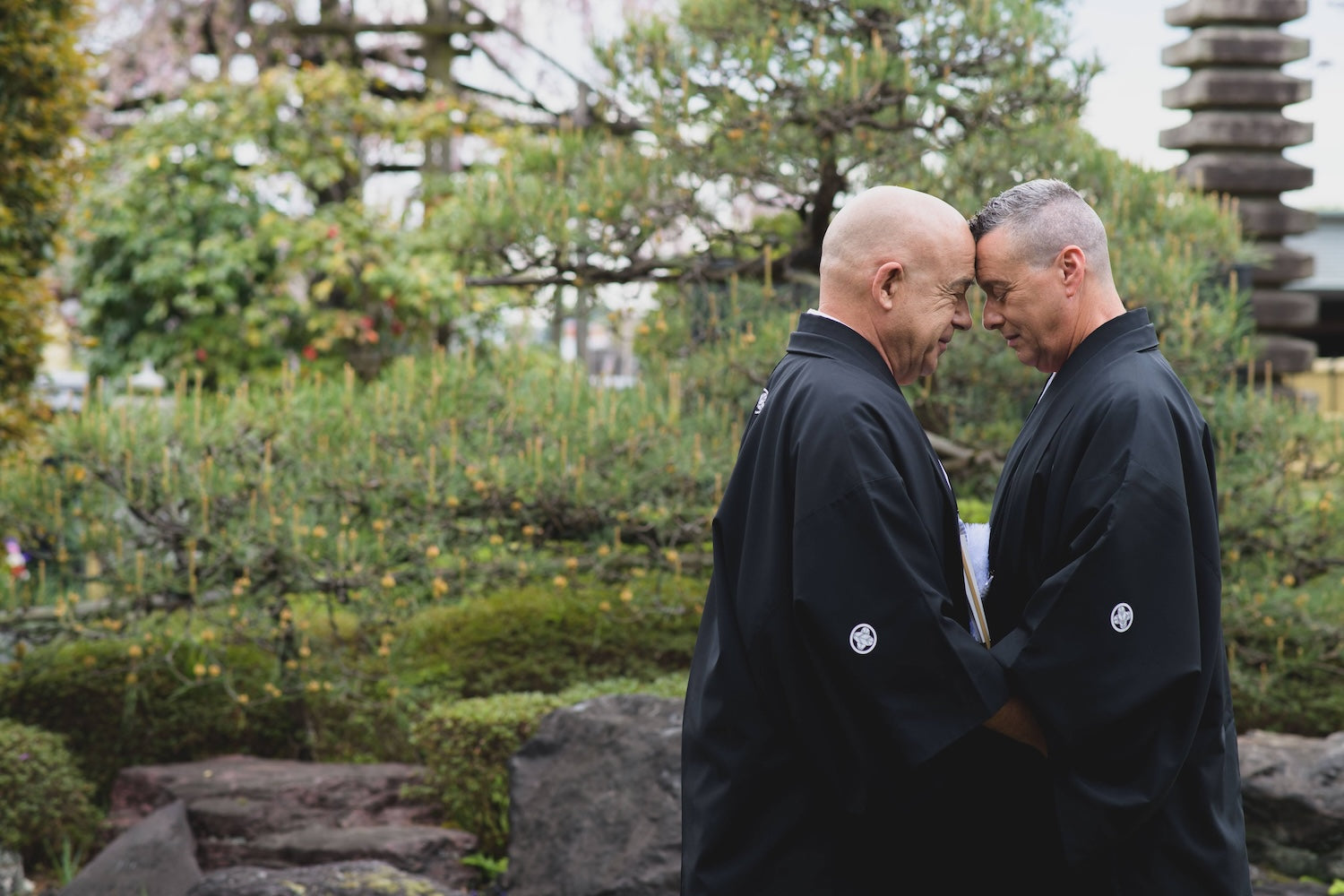
In short: A same-sex couple may be able to have a Shinto or Buddhist wedding ceremony in Japan, but acceptance is not uniform and must be confirmed for the specific venue and date. WAKON STYLE welcomes couples regardless of gender, sexuality, or nationality and can discuss suitable options, while keeping ceremonial availability separate from questions of legal recognition.
There is very little clear, practical information online for LGBTQ+ couples wondering whether a traditional Japanese wedding ceremony is genuinely open to them. What does exist is often either overly cautious, implying it is simply not possible, or vague in a way that avoids the real question. This guide sets out what can honestly be said today, what still needs to be confirmed case by case, and how to approach that conversation with a coordinator.
This guide will not promise a guaranteed yes, and it will not repeat a discouraging no either. Both would be dishonest, given how much genuinely depends on the specific shrine or temple, the date, and the format of ceremony you are hoping for. What follows is written to give you an accurate starting point, so that your first conversation with a coordinator is an informed one rather than a hopeful guess.
Table of Contents
- Can same-sex couples have a Shinto wedding ceremony in Japan?
- Why does the answer vary by shrine or temple?
- Are there venues with a public track record of welcoming same-sex couples?
- Is the ceremony the same as legal marriage recognition?
- How can LGBTQ+ couples find a suitable wedding venue?
- How does WAKON STYLE support LGBTQ+ couples?
- FAQ: LGBTQ+ couples and Shinto weddings
- Who supervised this guide?
Can same-sex couples have a Shinto wedding ceremony in Japan?
It may be possible, but the answer depends on the individual shrine or temple and cannot be assumed from a general rule. Couples should confirm availability through a coordinator before making travel or ceremony plans.
Same-sex ceremonies at traditional Japanese venues do take place, and public accounts of couples who have gone through this process, including as part of WAKON STYLE's own published client stories, exist as real examples. What those accounts do not support is a blanket assumption that any given shrine or temple will say yes on request. Policies differ by venue, and availability must be confirmed individually rather than assumed from a fixed public policy. For that reason, this guide will not attempt to state a single yes-or-no answer that applies everywhere in Japan; instead, it explains what shapes the answer and how to approach it for your own plans. WAKON STYLE's dedicated LGBTQ+ page is the place to see the most current public information and examples.
Why does the answer vary by shrine or temple?
Each shrine or temple sets its own ceremonial policies and practical conditions, so one venue's answer does not establish a rule for another. Availability may also depend on the requested date, ceremony format, and what can be formally confirmed at the time of enquiry.
There is no single national rule governing whether a shrine or temple will perform a same-sex wedding ceremony, and it would be misleading to suggest otherwise. Shrines and temples are independently run religious institutions, each with its own approach, and a willingness to hold a ceremony for one couple does not automatically extend to every future request. This is not a reflection on the couples asking, nor a judgment this guide is positioned to make about any individual venue; it is simply the practical reality of a landscape where policies are set venue by venue rather than centrally. Where public information is limited, the honest answer is that it needs to be confirmed directly rather than inferred from a general impression.

Are there venues with a public track record of welcoming same-sex couples?
Yes. WAKON STYLE's dedicated LGBTQ+ page publicly names five venues with a track record of welcoming same-sex couples: Ekoin Temple, Goryou Shrine, Saimyouji Temple, Nishi Honganji Temple, and Nomiyama Kannonji Temple. These are named examples, not a guarantee that any of them will accept every future request.
Four of these five are Buddhist temples rather than Shinto shrines. This pattern is consistent with a general tendency: many Shinto shrines enshrine a paired male and female deity as part of their founding tradition, which can make some shrines more hesitant to hold a same-sex ceremony, while temples more often prove open to it. This is a general tendency rather than a fixed rule, and it does not mean every temple accepts every request or that every shrine declines. If one of these five venues fits your preferred area and date, it is a reasonable starting point for a conversation with your coordinator; if it does not, that does not mean no other venue will say yes, since policies are set independently, venue by venue, as explained above.

Is the ceremony the same as legal marriage recognition?
No. The availability of a religious or ceremonial wedding and the legal recognition of a marriage are separate questions. This article does not provide legal advice; couples should verify current requirements with the relevant official authorities for their own circumstances.
It is worth keeping these two questions clearly apart. Whether a shrine or temple will hold a ceremony is a matter of that venue's own ceremonial policy. Whether that ceremony carries any form of legal marriage recognition, in Japan or in a couple's home country, is a separate legal matter that depends on jurisdiction and current law, and it falls outside what this guide can responsibly address. Couples for whom legal recognition is a priority should raise that question with the appropriate legal or governmental authorities in their own situation, rather than assuming a ceremony resolves it either way.
How can LGBTQ+ couples find a suitable wedding venue?
Start by sharing your preferred area, date, ceremony style, and guest plans with a coordinator who can confirm current venue policies directly. Do not rely on an old list or assume that a venue's past response guarantees availability for a new request.
What information should you prepare before asking?
Having a clear sense of your preferred area, date, ceremony format, and guest numbers in advance makes it easier for a coordinator to check current options on your behalf. This does not need to include more personal information about your relationship than any other couple would share when planning a wedding.
Why should current availability be confirmed privately?
Policies and circumstances can change over time, so a venue that was open to a same-sex ceremony in the past is not automatically confirmed to be available for a new date today, and the reverse is also true. Rather than relying on secondhand lists of shrines or temples, checking current availability directly through a coordinator gives you a more reliable answer for your specific plans.
What should you avoid assuming?
A published example of one successful ceremony does not mean every date, format, or request will be accommodated in the same way, and no single region or type of venue should be assumed to be uniformly more open than another. Treating each enquiry as its own conversation, rather than extrapolating from someone else's experience, tends to produce a more accurate picture.
How does WAKON STYLE support LGBTQ+ couples?
WAKON STYLE states that it welcomes couples regardless of gender, sexuality, or nationality. Its wedding support can include venue selection and booking, attire and dressing, bilingual interpretation, a dedicated assistant, and preparation for the ceremony, subject to the confirmed venue and plan.

What support is included in the wedding package?
The same core elements described for the WAKON STYLE Shinto Wedding Package apply here: shrine or temple selection and booking, traditional attire and dressing, bilingual interpretation, a dedicated assistant, and preparation support. For couples holding a Shinto ceremony, the same ceremony structure applies as well. What is not assumed in advance is any specific additional service exclusive to LGBTQ+ couples beyond this same standard of support.
What does the existing LGBTQ+ page confirm?
WAKON STYLE's dedicated page for LGBTQ+ couples states plainly, "We proudly welcome all couples, regardless of gender, sexuality, or nationality." That page also shares a small number of client experiences in its own words. Rather than repeating those accounts here, this guide points readers to that page directly, since it is kept current and is the appropriate place to read those stories in full.
What should couples ask first?
The most useful starting point is a direct conversation: your preferred date, guest numbers, ceremony style, and any specific concerns you want addressed before committing to a plan. Framing the enquiry this way, as a request to be answered for your specific situation, tends to produce a clearer and more honest answer than searching for a generic guarantee.
FAQ: LGBTQ+ couples and Shinto weddings
Venue policies must be confirmed for the specific request, and ceremonial availability should not be confused with legal recognition. These answers clarify what couples can safely establish before contacting a coordinator.
Does every shrine accept same-sex wedding ceremonies? No uniform answer applies to every shrine. Acceptance and ceremony conditions must be confirmed with the individual venue.
Are there traditional Japanese wedding options besides a Shinto shrine? Some couples may also consider a Buddhist temple ceremony, but availability still needs to be confirmed for the specific venue and date.
Are any specific venues publicly known to welcome same-sex couples? Yes. WAKON STYLE's LGBTQ+ page publicly names five venues with a track record of doing so: Ekoin Temple, Goryou Shrine, Saimyouji Temple, Nishi Honganji Temple, and Nomiyama Kannonji Temple. Other venues may also be open to it, and availability should still be confirmed directly.
Does a ceremony determine our legal marriage status? No. Ceremonial availability and legal recognition are separate matters, and current legal requirements should be checked with official authorities.
Will WAKON STYLE work with LGBTQ+ couples? WAKON STYLE states that it welcomes couples regardless of gender, sexuality, or nationality and can discuss suitable ceremony options.
What information should we include in our first enquiry? Share your preferred area, date, ceremony style, guest plans, and the support you need so current options can be checked accurately.

Who supervised this guide?
Supervised by Etsuko Inoue, WAKON Wedding Producer
View Etsuko Inoue's full profileEtsuko Inoue has produced international weddings since 2017 and personally supports couples navigating exactly these questions, regardless of gender, sexuality, or nationality. Her profile shares more about her background.
If you are considering a Shinto or Buddhist wedding in Japan, contact WAKON STYLE and share your preferred date, area, and ceremony plans so we can check what options may currently be available.
Contact Us

